When Tshering Tobgay was a boy in a Bhutanese village, his grandmother wouldn’t let him point at the mountain behind their house. That, she told him, was where the guardian spirit of the land lived. Cut a tree without asking, or disturb a stream without a word of respect, and misfortune would follow the family.
At the time, Tshering did not understand this as “conservation” – but simply as how the world was. “The forest was not empty. The mountain was not just rock. The lake had a name, and a temper of its own.”
“This is the quiet inheritance of nearly every Bhutanese child,” he continued. “Long before we had environmental laws, we had sacred geography. Our highest peaks were never climbed — not because we lacked the ability, but because we understood them as the seats of protective deities. Our lakes were treated as living beings, home to spirits capable of blessing or cursing a village depending on how they were treated. Entire forests were declared sacred sites where no axe could fall and no animal could be hunted. Even today, building a home requires first asking permission of the local spirit through ritual, an acknowledgment that we were guests on land that was never fully ours to claim. This was not sentiment. It was governance — unwritten, but absolute. Generation after generation, our landscape was kept whole not by enforcement, but by reverence. Nature was never a resource to be managed. It was a relationship to be honored.”
Tshering told this story last week in New York — this time as Bhutan’s Prime Minister, at an event alongside the UN General Assembly. Then, he pivoted, announcing that his nation would become the first in the world to adopt a new measure – one rooted in Bhutan’s ancient reverence of nature, but updated with our best understanding of environmental science: the Gross Ecosystem Product, or “GEP”.
In the same way that Gross Domestic Product measures the productivity of Bhutan’s economy, and its long-celebrated assessment of Gross National Happiness measures the wellbeing of its people, the Gross Ecosystem Product is is an estimate of the value of what Bhutan’s forests, rivers, soils and mountain landscapes contribute to its people and its economy in a single year. In 2024, Tshering announced, that number was at least $6.2 billion US – about twice the size of Bhutan’s GDP – and likely to grow higher.
Assigning a discrete number to the value of nature is a complex task. A forest that stabilizes a hillside, filtering a watershed and storing carbon, is doing enormously valuable work. But almost none of that work is bought or sold. So in the economic statistics most governments steer by, it barely registers. That is, until the forest is cut down, at which point the timber shows up as income.
Gross Ecosystem Product is an attempt to fix that blind spot. It’s a single statistic that summarizes the value of nature’s contributions to economic activity in a given place over a given period. It’s intended to be GDP’s missing sibling: where GDP captures the market value of goods and services an economy produces, GEP expresses the value of the services its ecosystems produce.
Developed with the help of Stanford University’s Natural Capital Alliance, Bhutan’s GEP accounting sorts nature’s work into three categories of “services”. Each one tells a different story about what a landscape actually does for the people who live in it:
- Regulating services are the invisible ones: the work forests and soils do quietly, in the background, every single day, whether or not anyone is watching. Bhutan’s forests pull carbon dioxide out of the air, a service that benefits not just Bhutan but everyone on the planet. (Carbon alone, the Prime Minister noted, is worth more than four billion dollars a year — value that disappears the instant a forest is cleared.) Those same forests hold the hillsides in place, keeping sediment out of the reservoirs that feed the country’s hydropower plants. In other words, the trees are quietly protecting the power grid. Nobody sends them an invoice.
- Material services are the tangible ones: the physical goods ecosystems hand us directly. In Bhutan that means the water that spins its hydropower turbines, and the fuelwood, crops, timber, livestock and forest products that sustain rural life across the country. If regulating services are nature’s infrastructure, material services are its pantry. They’re a daily reminder of how completely Bhutan’s farmers and villages still depend on the living world around them.
- Non-material services are the hardest to price, and in some ways the most psychologically resonant. This is the value of the experience of nature and culture itself – what happens when, as Tshering, noted a visitor “stands before our sacred landscapes, walks our ancient trails, and returns home carrying a piece of Bhutan with them.” In many ways, this harkens to work underway on the Nature Relationship Index, which I’ve written about elsewhere.)
The benefit of GEP is in making these services commensurable. You can’t directly compare the intrinsic value of a cubic meter of clean water to a ton of stored carbon or a trekker’s afternoon in the Himalayas. So GEP converts each service into monetary terms first – using market prices where they exist, the cost of replacing a service with engineered infrastructure where they don’t, and other established valuation methods – and then adds them up.
GEP focuses on benefits that actually reach people, not on abstract ecological stocks. And it’s modular: a country can start with the services it can measure well today and add more as better data arrives and skills improve tomorrow. Bhutan’s first GEP assessment doesn’t yet include flood mitigation, water purification, air purification or the health benefits of time spent in nature. The $6.2b is thus a floor, not a ceiling.
GEP’s intellectual lineage moved from East to West and back again. The core ideas behind it were first proposed in 2013 by Chinese scientists Zhiyun Ouyang and Chunquan Zhu, who were looking for ways to help a fast-growing and rapidly-urbanizing China understand the value of keeping its forests, grasslands and rivers intact. The idea was then picked up and honed into a rigorous, repeatable accounting method by Stanford’s Natural Capital Alliance, led by the renowned ecologist Gretchen Daily. Daily’s team and Ouyang’s team, along with researchers from the University of Minnesota and the Stockholm Resilience Centre, worked to turn GEP into a rigorous, repeatable accounting method. Since then GEP has been used for land-use planning, designing payments for ecosystem services, and structuring green finance in countries as diverse as Italy, Colombia and Mongolia. In March 2021, the UN Statistical Commission approved GEP as an indicator of sustainable development – signalling its graduation from academic concept to global statistical tool.
Bhutan’s effort builds directly on this lineage – becoming the first-ever government to adopt GEP for an entire nation.
There are, of course, many who are made understandably queasy by the valuing of nature in economic terms – and I’ll confess to a twinge myself. Economies exist within natural systems, after all, and not the other way around. Putting a dollar figure on a forest may imply it can be traded for anything else worth the same amount; the mountain the Prime Minister’s grandmother wouldn’t let him point at could become, in principle, fungible with a highway.
There’s also something about dollar denomination that, weirdly, masks ambiguity with precision, rather than obfuscation. The numbers result from contestable choices; which carbon price was used, which replacement cost was assumed, which discount rate for a natural asset was embedded in a model are all critical decisions – yet in the final form, the valuation arrives wearing an aura of precision it may not truly embody. Such measurements can also underaccount for thresholds: the last intact watershed isn’t just as valuable as the first – it’s infinitely more so.
Inescapable questions of power and equity also lurk at the periphery. Once nature becomes an asset class, there’s the question of who captures the returns, and whether they flow to investors rather than to the villagers who kept the forests standing. Offsets can harden into a price list for destruction. And perhaps the subtlest risk is “crowding out” other measures of value: the moment we justify protecting something on economic grounds, we can weaken the moral and sacred reasons that protected it in the first place – which may leave it undefended on the day the numbers point the other way.
Bhutan’s integrated approach – a three-legged management tool that includes Gross Domestic Product (GDP, Gross National Happiness (GNH) and GEP – goes a long way toward alleviating those concerns. Bhutan is a resource-rich country in need of development, and measuring human, economic and ecological wellbeing together makes it possible to explicitly assess and protect what matters, make explicit the unavoidable tradeoffs along the way, and chart new, more intentional, authentically Bhutanese pathways to growth.
That’s exactly how Tshering framed it. “For decades, Bhutan has believed that development cannot be measured by economic growth alone. By measuring GEP alongside GDP and GNH, we recognize nature as the foundation of our economy and wellbeing. What we measure, we value. What we value, we protect. And what we protect today will sustain Bhutan for generations to come.”
What we measure, we value. What we value, we protect. That is the whole argument in nine words.
It would be easy – and a mistake – to file all this under “charming Himalayan exceptionalism”. Bhutan’s embrace of GEP alongside GNP and GNH points at a reformulated version of development and capital allocation that the world desperately wants and needs. A working example of a sovereign nation putting a GEP figure next to its GDP, and committing to update it, changes the conversation from “could this work?” to “why aren’t you doing it?” In Bhutan, other governments now have a template, a methodology and, most importantly, a peer to call.
GEP will also be a platform for additional innovation. Once nature’s contributions are expressed in the language of capital, they can anchor new financing instruments that account for the fuller-picture of the economy. Bhutan has already sketched what it intends to explore, including parametric insurance products triggered by GEP thresholds, so that climate-shock recovery can be fast and focused on restoring natural systems; GEP-linked green bonds that channel investment directly into ecosystem services; and a fair, direct offsetting obligation for any development that diminishes GEP, so those who draw down natural capital help restore it.
A similar dynamic will happen in the world of technology and data. Increased demand for environmental accounting will drive demand for the data and related analytical technologies that make it possible, driving down costs, improving performance, and further removing barriers to adoption.
Measuring GEP also makes clear which choices and which growth paths strengthen or weaken the country’s overall resilience, and how. Bhutan’s hydropower depends on glacier- and rain-fed rivers, its farms on healthy soils, its tourism on intact forests – and a true-cost economy, enabled by GEP, helps recognize them for what they are: critical infrastructure, not just now, but for the future.
As Tshering noted, “a country that only counts what it extracts will eventually have nothing left to count. A country that also counts what it protects secures its prosperity for generations to come.”
It’s a line that ought to hang in the office of every finance ministry on Earth.
You can read more about Bhutan’s adoption of GEP here, here and here.
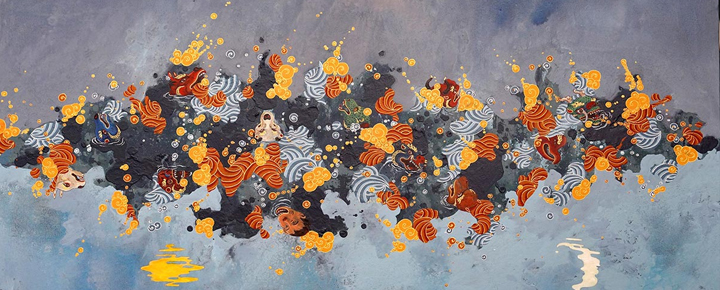
Samsara (detail) by Pema ‘Tintin’ Tshering